What happened
A full day, nine until five, and the first ninety minutes of it were not about design at all. Introductions, an icebreaker, then problem collection and dot voting, so the room arrived at a shortlist of its own problems before anybody put a definition on a screen. The teaching started at a quarter to eleven with why, moved to what, and only reached how after lunch.
The what began with a wall of definitions, deliberately too many to read. Charles Eames on a plan for arranging elements to accomplish a purpose. Bruce Mau on the human capacity to plan and produce desired outcomes. Richard Buchanan at length on design as a practical discipline of responsible action. The International Council of Design being careful and institutional. Then the same wall again with one more line added at the bottom, in the register everybody in a room of non-designers actually arrives holding: a thing which decorates.
The joke that does real work was John Heskett's, which reads like nonsense and is not: design is when designers design a design to produce a design. Four senses of one word, and the slide takes them apart. The field, the act, the plan, the outcome. The distinction between design and art came next and was blunt about it: design responds to a problem and its success is objectively measurable, and the solution is reproduced or experienced serially rather than once.
Good design got a one-line answer, that it contributes value, followed by the ten principles Dieter Rams is known for, which end where they always end, on as little design as possible. The method underneath was compressed to a formula worth keeping: design is making sense plus giving form, driven by two questions. Why are things the way they are, and how can we make them better. Then the ordinary loop of research, ideation, prototyping and testing, and implementation, with the elements and the principles of composition alongside it.
The most interesting decision in the deck comes near the end, and it is a strange one for a beginners' workshop. Two enormous lists, one of well over a hundred named design principles running from the eighty-twenty rule to the weakest link, and one of a hundred numbered methods from A/B testing to word clouds. Nobody was going to learn those in an afternoon and nobody was meant to. Shown to a room of non-designers they say something the definitions cannot: that this is a discipline with a literature, and that the thing they thought was decoration has several hundred years of people arguing about it underneath.
What was promised
Hands-on Workshop
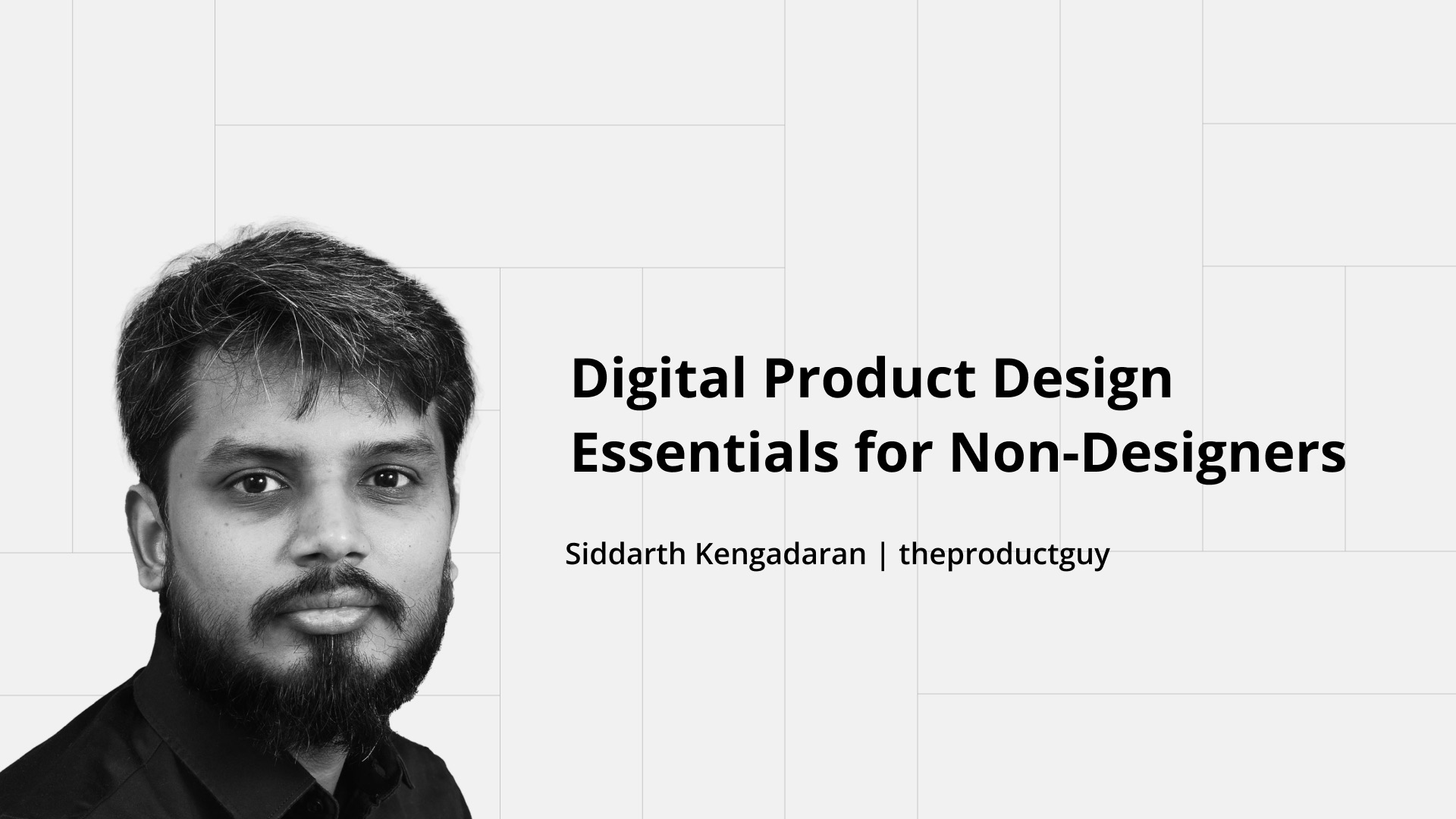
Siddarth Kengadaran
theproductguy
Product consultant specializing in user-centric design, with a proven record of accomplishment in developing innovative digital products using Agile frameworks. He blends his deep understanding of technology with applied psychology to craft ethical and impactful user experiences.
About the session
Overview
Curious about the forces that shape our digital experiences? Join us for a free one-day workshop where we'll unlock the secrets behind user-friendly and engaging digital products. This collaborative event is designed for individuals with a keen interest in design thinking and its application in the digital realm.
Who is this workshop for?
This workshop welcomes anyone eager to explore the world of digital product design. Whether you're a product manager, marketer, developer, student, entrepreneur, or simply fascinated by technology's impact on our lives, this workshop offers valuable insights.
No prior design experience is required!
What will you learn?
Fundamentals of Digital Product Design Grasp the core principles of user-centered design, usability, and accessibility.
The Design Thinking Process Discover how to apply the design thinking framework to solve problems and create user-centered digital products.
User Research Methods Explore techniques to understand user needs and behaviors, including usability testing, user interviews, and more.
Information Architecture and User Flows Learn how to organize information effectively and design intuitive navigation for digital products.
Prototyping Get hands-on experience with Figma to bring your design ideas to life.
Testing and Iteration Understand the importance of user feedback and learn how to test and refine your designs.
Visual Design Basics Learn the fundamentals of typography, color theory, and layout to create visually appealing interfaces.
Why should you attend?
Gain a competitive edge In today's digital world, understanding design is a valuable asset across various fields.
Improve your communication Learn to speak the language of design and collaborate effectively with designers.
Become a better problem solver Apply design thinking principles to tackle challenges in any area of your life.
Boost your creativity Unleash your inner designer and explore new ways of thinking.
Workshop Format
This interactive workshop will combine presentations, group discussions, hands-on activities, and real-world examples to provide a comprehensive and engaging learning experience.
Collaborative Approach
To foster a sense of community and shared learning, participants are kindly requested to contribute towards lunch and material costs. This collaborative approach ensures an enriching experience for all attendees.
About the Facilitator
Siddarth Kengadaran is a dynamic Product Strategist with expertise in AI, AR, and user-centric design. He has a proven track record of leading the development of innovative digital products within Agile frameworks. Siddarth combines deep knowledge in technology with applied psychology to ensure ethically sound and impactful user experiences.
Tools and Resources
We'll be using Figma for prototyping and FigJam for online whiteboarding during the workshop. Don't worry, we'll provide you with all the necessary instructions and support. Bring your laptop fully charged.
Register now and join our design thinking community!
Venue
Kovan Labs,
Avinashi Rd, TNHB Colony, Indira Nagar,
Civil Aerodrome Post,
Coimbatore, Tamil Nadu 641014