What happened
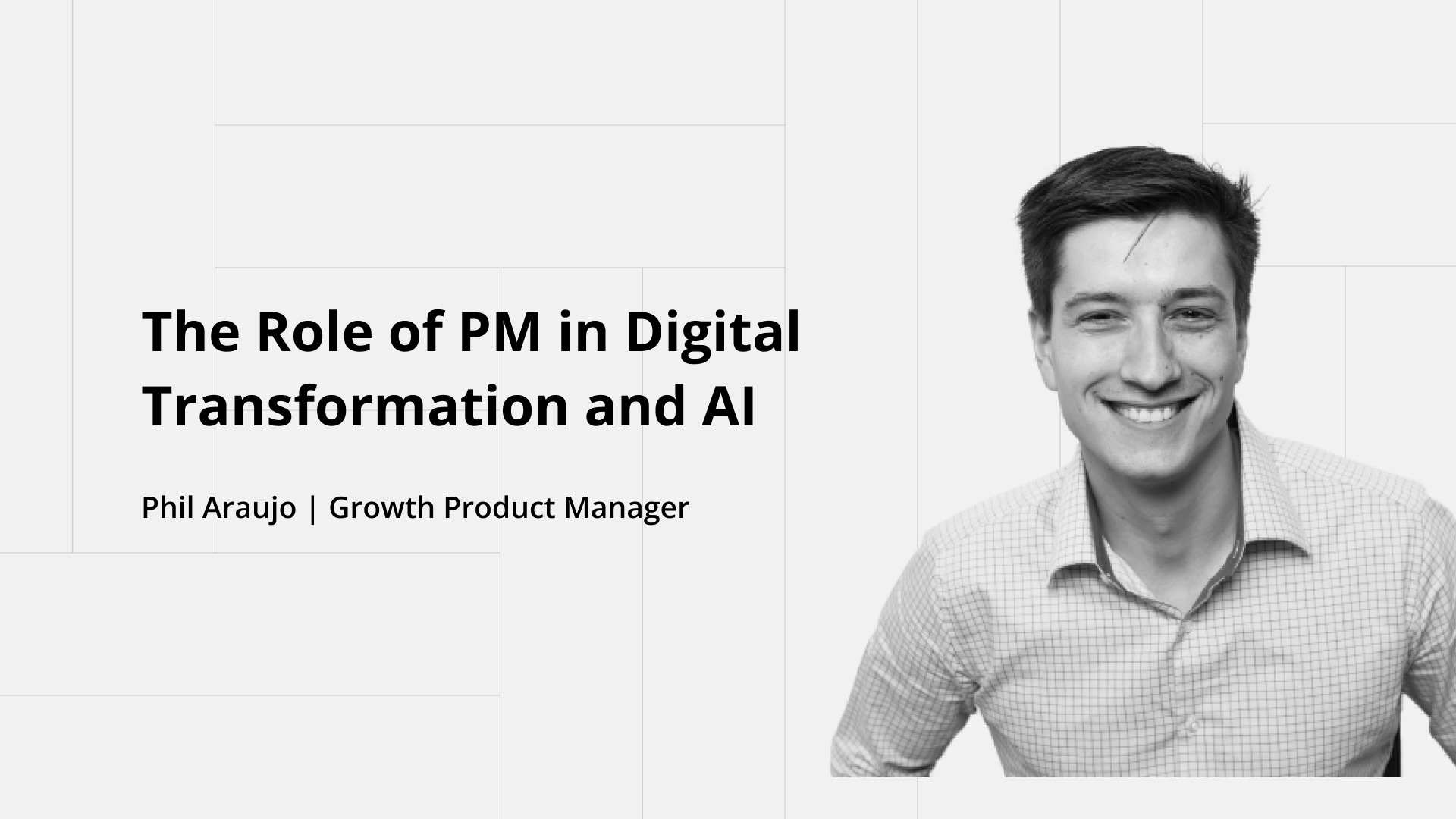
Phil Araujo has been a product manager for more than fifteen years, across connected cars, HR, banking and insurance, and he spent the first half of this session on history rather than on AI, because he thinks the context is the part people skip. He opened with Minority Report. The novel never described its world, so the film's makers convened a group of Silicon Valley experts to work out what 2040 would look like, and much of what they drew is arriving about twenty years early.
The distinction he most wanted to land was that digital transformation is three things people run together. Digitization is putting the paper maps into a computer. Digitalization is when the processes around those maps, updating them and getting access to them, stop being paper too. Digital transformation is the third and quite different thing: new business models, new services, a different culture. Companies announce the third while doing the first.
He set the same trap under AI using a hierarchy of needs shaped like Maslow's. Quality data foundation, then processing, then analytical insight, then decision making, and only then a competitive advantage. His point was that using AI is not itself an advantage and that people try to start at the top. His own example was honest about this: at a vehicle company with three hundred thousand vehicles in Europe and twenty years of data, he set out to predict what a car would cost to run for a given driver, and the first finding was that the data was not clean and some of it was missing. The delivery, for a while, was cleaning it. They could only go back and reprocess because whoever built the platform had made that possible.
The shift he thought hardest for product managers is from a deterministic mindset to a probabilistic one. A first AI iteration will not be as good as anyone expects, and it improves with traffic and data, but stakeholders still turn up expecting to be impressed on day one. He also argued for a third track alongside the usual discovery and delivery, a data track where an engineer establishes whether the data to support an idea actually exists, and was unbothered by people telling him that is no longer agile.
Some of the job is genuinely new. Product data strategy means negotiating with external suppliers for data, building features whose purpose is to acquire data, and writing the instructions by which somebody else labels it, in the way films are tagged for a recommendation engine. And he was clear about the part that does not get easier: you cannot build a confident roadmap when you do not know the state of your own data, the path is not straight, and nobody in the market is waiting for you while you find out.
What was promised
1. Understanding AI in the Business Context
2. The New Landscape for Product Management in the AI Era
3. The Intersection of AI and Product Management
4. The Role of Product Managers in Driving AI Implementation
5. Challenges and Future of Product Management in the AI Age
Phil Araujo
Growth Product Manager